
Merchant API
/v1 is the API a merchant's own backend calls. Its object model, form encoding, error envelope and idempotency semantics are Stripe's, so an existing Stripe integration reads naturally against it. Its authentication is not Stripe's: there is no API key, only a short-lived bearer token obtained with OAuth2 client_credentials + private_key_jwt (see Authentication).
Every route below is real — it answers with real rows from a real Postgres — but the rails behind the money-moving ones have only ever been WireMock stubs, apart from one MTN sandbox charge on 2026-09-15. Read Status before you build on anything here.
Agents working on this surface should load vpay-merchant-api.
Four surfaces, four credential models
vpay exposes three authenticated HTTP surfaces and one public callback path. They are kept apart on purpose — the API reference calls conflating any of them a security bug.
| Surface | Caller | Credential | Page |
|---|---|---|---|
/v1 | the merchant's backend | bearer token from private_key_jwt | this section |
/v1/browser | the payer's browser | publishable key + the intent's (or session's) client_secret | Browser checkout |
/dash/v1 | a signed-in staff member | OIDC session (authorization code + PKCE) | Dashboard auth |
/provider/{code}/callback | a rail | none — a callback only pulls a status query forward, never changes state | Reconciler |
/v1/browser is not a second way into /v1: it has its own route table, its own 404 fallback and CORS, and exactly one route that is not a GET. /dash/v1 is mounted only on a deployment configured for the staff surface, and — like everything else — has never run in a deployment. The provider callback route is proven against WireMock and has never been called by MTN or Orange.
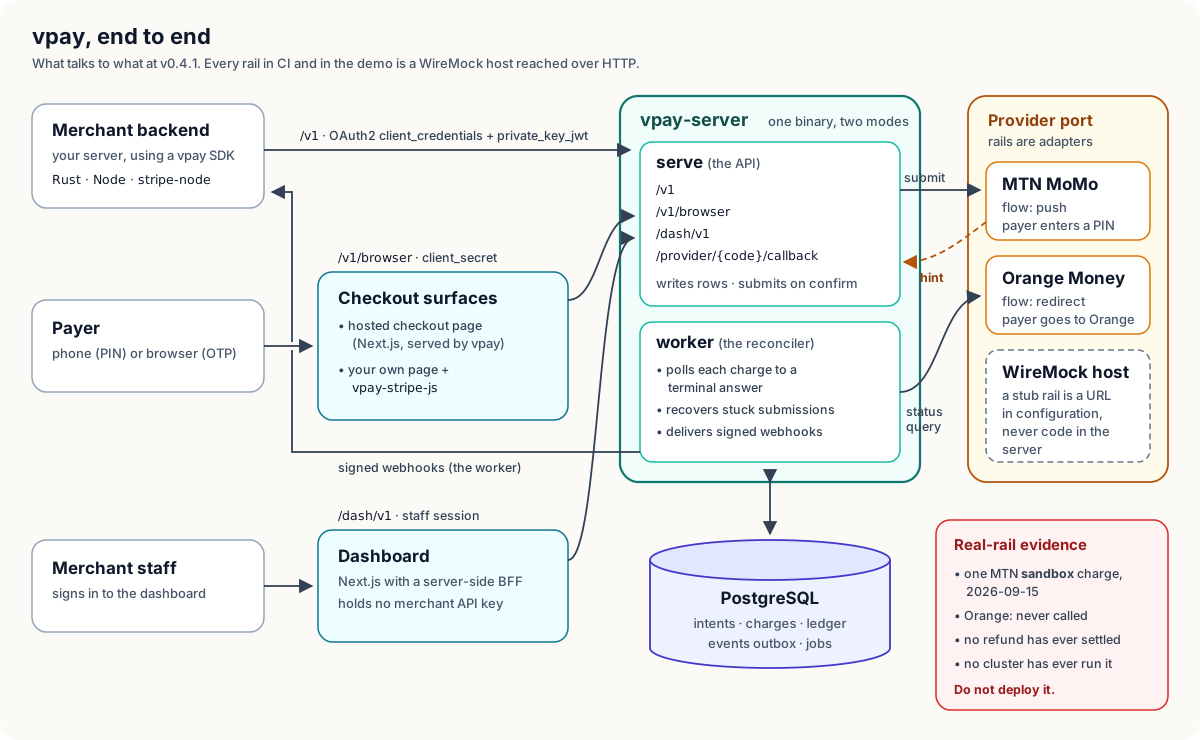
What is served on /v1
Unauthenticated, by necessity: GET /healthz and the merchant OAuth provider — POST /v1/oauth/token, GET /v1/oauth/.well-known/openid-configuration and GET /v1/oauth/jwks.json. Everything else sits behind a merchant bearer token and a scope check:
| Resource | Methods |
|---|---|
/v1/payment_intents | POST, GET, GET {id}, POST {id}/confirm, POST {id}/cancel |
/v1/checkout/sessions | POST, GET, GET {id}, POST {id}/expire |
/v1/customers | POST, GET, GET {id}, POST {id}, DELETE {id} |
/v1/invoices | POST, GET |
/v1/invoices/{id} | GET, POST, PATCH, DELETE |
/v1/invoices/{id}/finalize | POST |
/v1/invoices/{id}/void | POST |
/v1/invoices/{id}/mark_uncollectible | POST |
/v1/invoices/{id}/pay | POST |
/v1/invoice_items | POST |
/v1/invoice_items/{id} | GET, POST, PATCH, DELETE |
/v1/events | GET, GET {id} |
/v1/refunds | POST, GET |
/v1/refunds/{id} | GET, POST |
/v1/refunds/{id}/cancel | POST |
/v1/account_holders | GET |
The table is the constant vpay_api::V1_ROUTES, and a boundary test walks that constant rather than a list of its own, asserting every entry answers 401 without a token — so a route cannot be mounted without being covered.
POST and PATCH are one handler on /v1/invoices/{id} and /v1/invoice_items/{id}. Stripe's API has no PATCH, so an existing client sends POST; PATCH sits beside it because a partial update is what the verb means. There is no collection GET on /v1/invoice_items — an invoice's lines are read from the invoice.
flowchart LR
  OP["OAuth provider<br/>/v1/oauth/*<br/>(no token)"]
  subgraph Payments
    PI["/v1/payment_intents"]
    CS["/v1/checkout/sessions"]
    RF["/v1/refunds"]
  end
  subgraph Billing
    CU["/v1/customers"]
    IN["/v1/invoices"]
    II["/v1/invoice_items"]
  end
  subgraph Reads
    EV["/v1/events"]
    AH["/v1/account_holders"]
  end
  BAL["GET /v1/balance"]
  OP -- "bearer token + scope" --> Payments
  OP -- "bearer token + scope" --> Billing
  OP -- "bearer token + scope" --> Reads
  CS -. "references one" .-> PI
  RF -. "against one" .-> PI
  IN -. "bills one" .-> CU
  II -. "lines of a draft" .-> IN
  IN -. "pay mints" .-> PI
  BAL:::gone
  classDef gone stroke-dasharray: 5 5
  OP -. "not routed: 404" .-> BAL
Scopes
Two scopes exist: payments:write for any method that is not a read, and either payments:read or payments:write for GET/HEAD. A valid token with neither is a 403 forbidden, not a 401 — the credential is fine, it just authorises nothing. An authenticated request to a path with no route is 404 unknown_route.
Bodies and errors
Request bodies are application/x-www-form-urlencoded, bracket-nested the way Stripe's SDKs send them (metadata[order_id]=1234, payment_method_types[0]=mtn_momo; the unindexed [] spelling is accepted too). A JSON body is refused with a 400 telling you to send a form, and a body over 64 KiB is refused. Amounts are integer minor units — see Money.
Every non-2xx response the API renders is Stripe's envelope:
{
  "error": {
    "type": "invalid_request_error",
    "code": "…",
    "message": "…",
    "param": "…"
  }
}
The status, type and code are derived from one classification of the failing error, never chosen per handler, so the same failure always gets the same answer. message never carries hosts, table names or credentials. Two responses are produced above that renderer and carry an empty or plain-text body instead: a 405 (right path, wrong method) and a 413 (body too large). The full category table is on Errors.
Idempotency-Key is required on every POST
This is stricter than Stripe, where the header is optional. A POST without one is a 400 naming idempotency_key, before anything is created. Keys are 1–255 printable-ASCII bytes, scoped to your merchant, and kept for 24 hours. Both vpay SDKs, and stripe-node, send one on every POST automatically, so in practice this only bites a hand-rolled client.
| What you did | What you get |
|---|---|
| Same key, same body, first call finished | the stored response, byte for byte |
| Same key, different body | 400 idempotency_error / idempotency_key_in_use |
| Same key, first call still running | 400 idempotency_error / idempotency_key_in_flight |
First call answered 5xx | the key is released; the retry re-executes |
| Deployment changed under a replay | the replay still answers what the original did |
Stripe answers 409 for a key still in flight; vpay answers 400, because the status comes from the error's category. Branch on code, which is distinct either way.
The case that matters most is a confirm that timed out at the rail. The 502 releases the key, and the retry re-executes — which is safe, because it is not the key that prevents a second charge but the database rule "one charge per intent, forever":
sequenceDiagram
  autonumber
  participant M as Merchant backend
  participant V as vpay /v1
  participant DB as Postgres
  participant R as Rail
  M->>V: POST /v1/payment_intents/pi_x/confirm (Idempotency-Key K)
  V->>DB: claim K, commit a submitting charge
  V->>R: submit charge
  R--xV: no readable answer
  V->>DB: release K (a 5xx is never stored)
  V-->>M: 502 provider_unavailable
  M->>V: same call, same key K
  V->>DB: claim K again
  DB-->>V: this intent already has a live charge
  V-->>M: 409 "being resolved with the rail, poll GET"
  M->>V: GET /v1/payment_intents/pi_x
  V-->>M: the intent, as the worker resolves it
Do not open a second intent after a 502
On a push rail a second PaymentIntent prompts the payer's handset a second time for the same money. Retry under the same key, and if the answer is the 409 saying the charge is being resolved, poll the GET. Only a 409 saying the charge is terminal means "create a new intent".
Refunds: a 201 is not money back
The four refund write routes were mounted on 2026-09-16. A 201 from POST /v1/refunds means vpay wrote the refund as pending, reserved its amount against the intent, emitted charge.refunded in the same transaction, and instructed the rail. It does not mean money moved:
- nothing settles a
pendingrefund — the provider port has no refund status read and there is no refund poll ladder (RFC-0003 open question 8); mtn_momo::refundmakes MTN's Disbursementstransfercall, but no real Disbursements credential exists in the project and that product has never been called — it is WireMock-proven only;orange_money::refundis a declaredNotImplementedtoken, which fails the refund, releases its reservation and answers501.
destination[<payment_method_type>][msisdn] is required on both rails (a mobile-money refund is an outbound transfer and needs a payee), and POST /v1/refunds/{id}/cancel in practice refuses every refund the create route produces, because the rail has already been handed the transfer by the time you hold the re_….
GET /v1/balance is not routed
It answers the honest 404 from the nest's fallback, to an authenticated caller, because there is no ledger read path — a 200 would mean somebody invented a resource. Both SDKs can call it and get that 404.
Status in v0.4.1
| Part | Status | Evidence |
|---|---|---|
OAuth provider and the /v1 401 boundary | Built and tested | integration suites over a real router and Postgres, run in CI |
| Payment intents, checkout sessions | Partly built | real routes and rows; confirm reaches a rail that has only been a stub (one MTN sandbox charge) |
| Customers, invoices, events | Built and tested | container-backed integration suites through the shipping router |
| Idempotency | Built and tested | every row of the table above is a named integration test against a real Postgres |
| Refunds | Written, never run against the real rail | routes and rows are real; no rail has ever refunded and nothing settles pending |
GET /v1/balance | Not built | honest 404 |
Rate limiting on /v1 or /v1/oauth/token | Not built | left to an ingress nothing in the repository verifies |
The full record is docs/api/README.md and docs/status/backend.md.