
Hosted and embedded checkout
vpay serves its own payer page so a merchant does not have to build one. The merchant's server creates a Checkout Session against a PaymentIntent it already has, and either redirects the payer to vpay's page (hosted) or frames that page inside its own site (embedded). The page collects what the rail needs, confirms, waits for the outcome from vpay's API, and sends the payer back. It has been walked end to end in a real browser — but every rail behind it has been a WireMock stub, never MTN or Orange.
Agents working on this should load vpay-checkout.
The rule the whole design rests on
A payer's browser holds credentials for one checkout and nothing else, and every one of them expires. There is no bearer token, no cookie, and no server session beyond the session row. The strongest credential a payer can hold buys one confirm of one payment intent; the weakest buys a read of one session's outcome; both stop working 24 hours after the session was created.
The page authenticates exactly the way a merchant's own page would, through the /v1/browser surface described in Browser checkout.
The two modes
| Hosted | Embedded | |
|---|---|---|
| The merchant's server gets | a url | a client_secret |
| The merchant then | redirects the payer to it | hands it to @vaam-apps/vpay-stripe-js's initEmbeddedCheckout |
| URL a browser loads | {checkout.public_base_url}/c/{cs_id}?key={pk}#{client_secret} | {checkout.public_base_url}/e/{cs_id}?key={pk}#{client_secret} |
Framing (Content-Security-Policy) | frame-ancestors 'none' | frame-ancestors = the merchant's checkout_origins |
| Required on create | success_url and cancel_url | return_url |
| Where the payer ends up | success_url / cancel_url, top level | return_url, plus a vpay:complete message to the framing page |
Both modes render the same screens from the same state machine. The mode is fixed on the session at create, and the page refuses to run in the wrong one: /c/{id} refuses if it is framed, /e/{id} refuses if it is not.
A merchant can also open the hosted page in a popup with openCheckoutPopup — see Browser checkout.
The checkout session
checkout.session (cs_…) is one row in checkout_sessions. It references a PaymentIntent; it never creates one. Amount, currency and the rails on offer stay on the intent.
{
  "id": "cs_…",
  "object": "checkout.session",
  "livemode": false,
  "payment_intent": "pi_…",
  "ui_mode": "hosted",
  "status": "open",
  "payment_status": "unpaid",
  "success_url": "https://shop/ok?sid={CHECKOUT_SESSION_ID}",
  "cancel_url": "https://shop/cancel",
  "return_url": null,
  "url": "https://checkout.example/c/cs_…?key=pk_…#cs_…_secret_…",
  "expires_at": 1757000000,
  "created": 1756913600,
  "client_secret": "cs_…_secret_…"
}
The object is vpay's own and deliberately small: there are no line_items, no mode, no amount_total. Field names match Stripe's only where the meaning matches. {CHECKOUT_SESSION_ID} in a URL is a literal placeholder that vpay substitutes when it forwards the payer — it is the only thing vpay ever writes into a merchant's URL.
Routes
| Surface | Method and path | What it does |
|---|---|---|
/v1 | POST /v1/checkout/sessions | Creates a session (with client_secret, and url when hosted). Refuses an intent that is not requires_payment_method, already has a charge, or already has an open session |
/v1 | GET /v1/checkout/sessions/{id} | The session, with client_secret |
/v1 | GET /v1/checkout/sessions | A list, no secrets, filterable by payment_intent |
/v1 | POST /v1/checkout/sessions/{id}/expire | open → expired; 409 if the payer is mid-payment |
| browser | GET /v1/browser/checkout/sessions/{id}?key&client_secret | The session with the intent expanded and the intent's own client_secret, while open |
| browser | GET /v1/browser/checkout/sessions/{id}/return?key&t | The same, without the intent's secret — the return page's read |
| browser | GET /v1/browser/checkout/origins?key | The merchant's allowed framing origins |
The /v1 routes need a merchant token and an Idempotency-Key on POST, like every other merchant route. Every failure on the two browser session reads is one identical 404 — unknown key, wrong tenant, wrong credential, missing credential, past the horizon — so the answer cannot be used to probe which part of a link is wrong.
Lifecycle
stateDiagram-v2
    [*] --> open : POST /v1/checkout/sessions
    open --> complete : settlement, intent succeeded
    open --> expired : settlement, terminal decline
    open --> expired : merchant calls expire
    open --> expired : hourly sweep, 24 h horizon
    complete --> [*]
    expired --> [*]
Exactly four things move a session, and a payer's browser is not one of them:
- The settlement transaction flips the session in the same commit as the intent —
complete/paidon success,expired/failedon a terminal decline. POST /v1/checkout/sessions/{id}/expire, the merchant abandoning it. It refuses with409if a charge is live.- The worker's hourly sweep expires
opensessions pastexpires_atthat have no live charge, and emits onecheckout.session.expiredevent per session in the same transaction. - Nothing else.
Only the sweep emits an event. The settlement already emits payment_intent.succeeded / payment_intent.payment_failed, and a merchant who expired a session already knows. One open session per intent is enforced by a partial unique index, not just a handler check.
A session that is no longer open also refuses the confirm: both POST /v1/payment_intents/{id}/confirm and its browser twin answer 409 checkout_session_expired for an intent whose newest session is expired — even an open one past its horizon the sweep has not reached yet. That is what makes the 24-hour horizon a promise rather than a notification.
The payer's journey
The merchant's server does the two credentialed calls; the browser sees only the URL. MTN is a push rail (the payer approves on their handset); Orange is a redirect rail (the payer approves on Orange's own page).
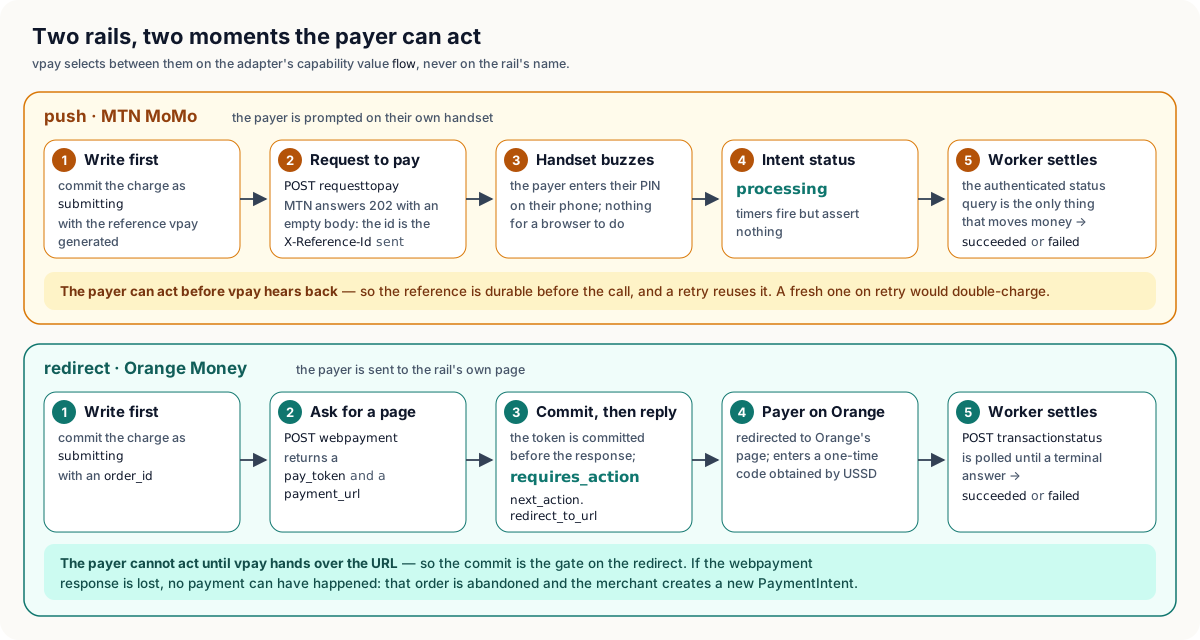
sequenceDiagram
    autonumber
    participant M as Merchant server
    participant V as vpay API
    participant P as Payer browser (vpay page)
    participant R as Rail (WireMock in every test)
    M->>V: POST /v1/payment_intents
    M->>V: POST /v1/checkout/sessions (ui_mode hosted)
    V-->>M: session with url
    M-->>P: redirect to url (secret in the fragment)
    P->>V: GET /v1/browser/checkout/sessions/{id}
    V-->>P: session plus intent and its client_secret
    alt MTN MoMo (push)
        P->>V: POST /v1/browser/payment_intents/{id}/confirm with msisdn
        V->>R: submit the charge
        Note over R: prompt on the payer's handset, payer enters PIN
        loop until terminal
            P->>V: GET /v1/browser/payment_intents/{id}
        end
    else Orange Money (redirect)
        P->>V: POST /v1/browser/payment_intents/{id}/confirm
        V->>R: submit the charge, with vpay's return page as return_url
        V-->>P: next_action redirect_to_url
        P->>R: payer approves on the rail's page
        R-->>P: back to /c/{id}/return?t=...
        loop until terminal
            P->>V: GET /v1/browser/checkout/sessions/{id}/return
        end
    end
    P-->>M: payer presses Back to merchant, lands on success_url or cancel_url
    V-)M: signed webhook payment_intent.succeeded
The return page is not the outcome
The payer arriving at success_url means only that their browser was pointed there. The merchant learns the outcome from the signed webhook; vpay's page learns it from an authenticated status query. The runbook's worked example marks an order paid from the webhook and from nothing else — see Webhooks.
Two credentials, and why
Secrets ride in URL fragments, never query strings, on vpay's pages: a fragment is never sent to a server, never logged, and never carried across a redirect. So the session's client_secret lives in the fragment and the page reads it in JavaScript.
A fragment does not survive a rail's redirect — which is exactly what the return page must survive. So a redirect charge is given a separate return_token (160 bits, in the query string as t), which buys a read of the session and a poll of its intent and nothing else. Because a copy of it ends up in the rail's logs, both reads stop at expires_at whatever the session's status.
Every vpay-served page also sends Referrer-Policy: no-referrer, Cache-Control: no-store and X-Content-Type-Options: nosniff.
What the page shows
frontends/apps/checkout keeps its logic in a pure reducer — no fetch, no timer, no DOM — so every transition is a unit test. The state names below are the reducer's own.
stateDiagram-v2
    [*] --> loading
    loading --> error : credentials missing (invalid link)
    loading --> refused : framed wrongly, or no rail this page can drive
    loading --> expired : session past its horizon
    loading --> outcome : session already finished
    loading --> waiting : intent already processing (a reload)
    loading --> resume_redirect : payer abandoned the rail page
    loading --> select_rail : intent offers more than one rail
    loading --> collect_msisdn : only MTN on offer
    loading --> ready_redirect : only Orange on offer
    select_rail --> collect_msisdn : MTN (push)
    select_rail --> ready_redirect : Orange (redirect)
    collect_msisdn --> confirming : confirm
    confirming --> waiting
    ready_redirect --> redirecting : confirm
    resume_redirect --> redirecting : payer presses the button
    redirecting --> [*] : the rail's own page
    waiting --> outcome : poll reaches succeeded, failed or canceled
    outcome --> forwarding : payer presses Back to merchant
    forwarding --> [*]
The screens, as vpay renders them
These are screenshots of vpay's own checkout components at v0.4.1, taken from the checkout app's Storybook (frontends/apps/checkout, story file checkout-screens.stories.tsx). The data is the repository's test fixture: a 5 000 FCFA session for "Boutique Test", with reference cs_test_fixture000000000001. It is the same set of states checkout-view.test.tsx asserts against, and that vpay's Storybook accessibility gate renders in Chromium. The "Mode test" banner is real. The page shows it whenever the session is not livemode. French is the default locale, and two screens are shown in English.
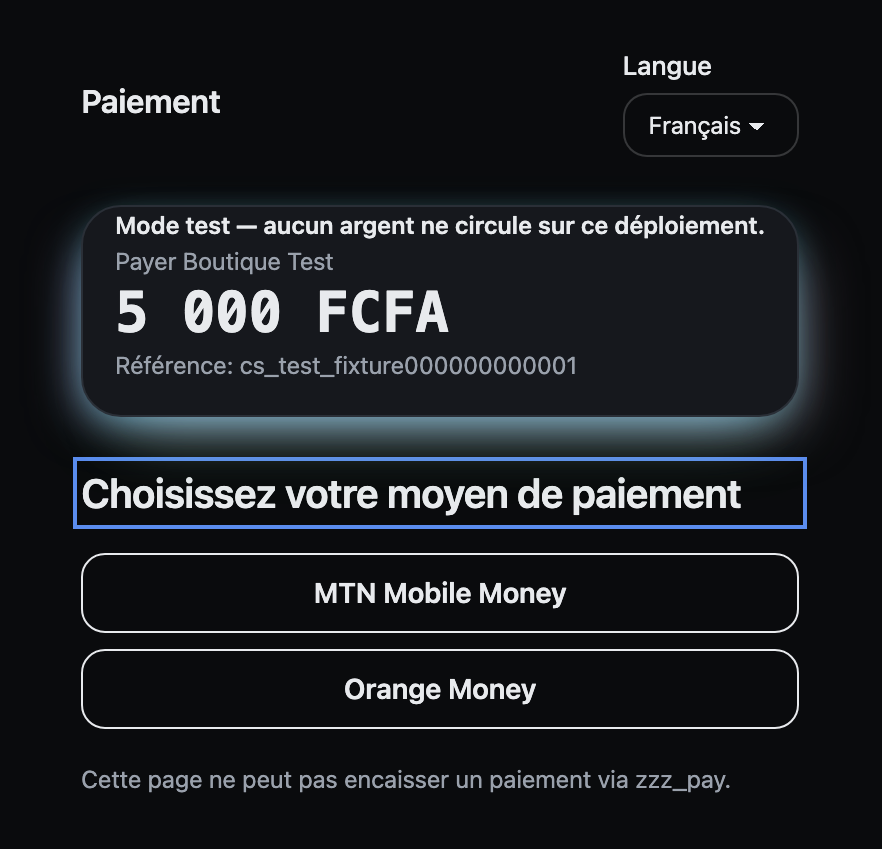
select_rail: more than one rail on offer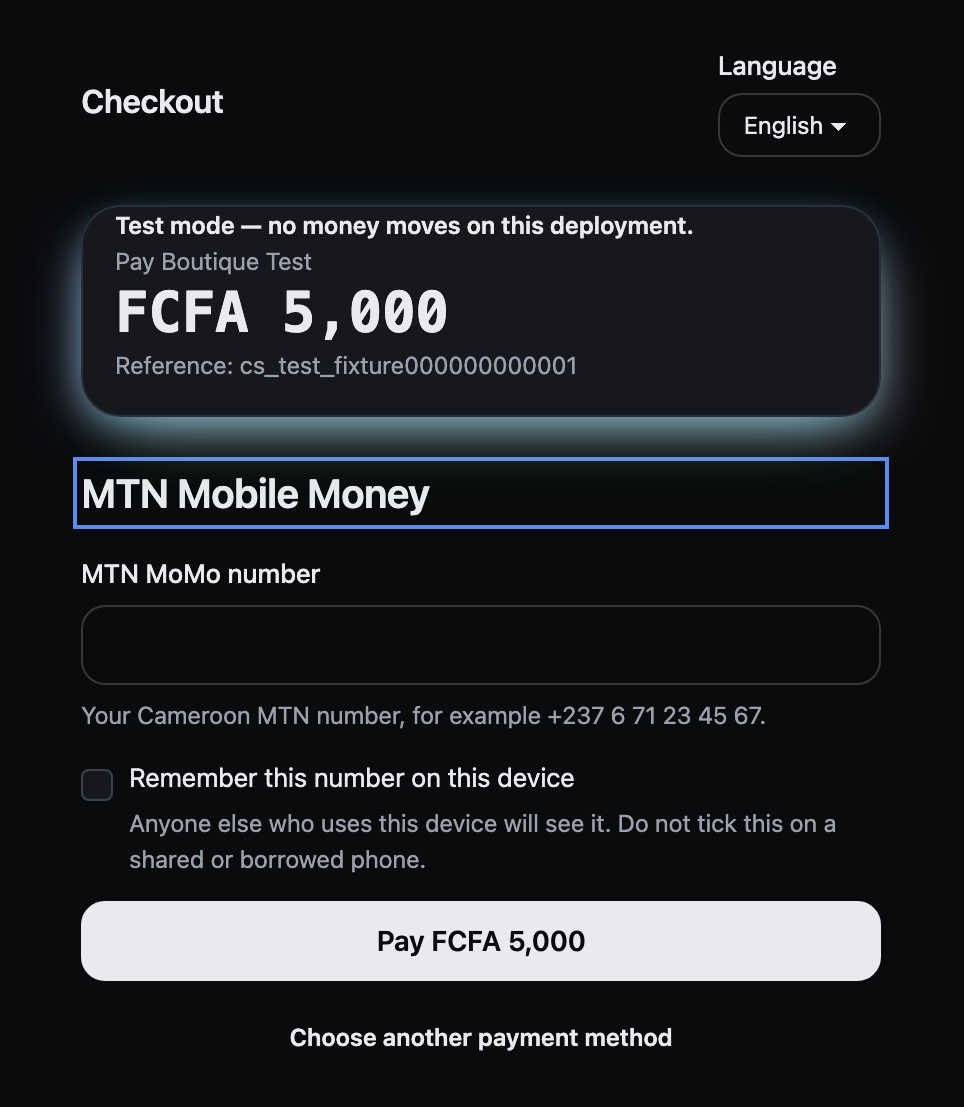
collect_msisdn: the MTN number, before confirm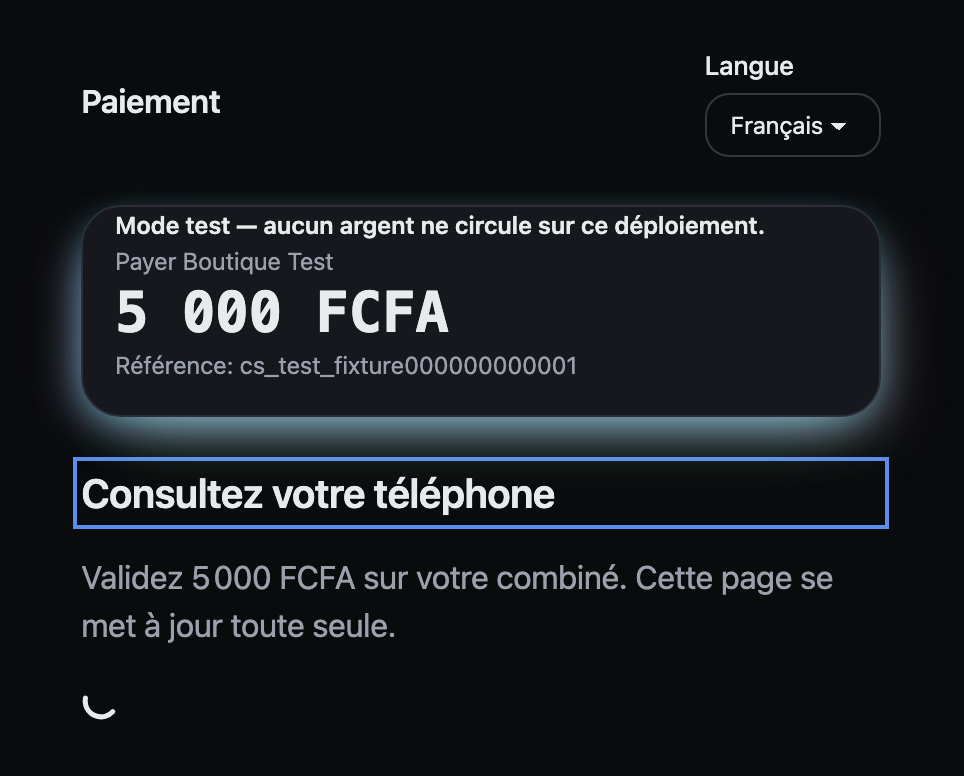
waiting: the payer approves on their handset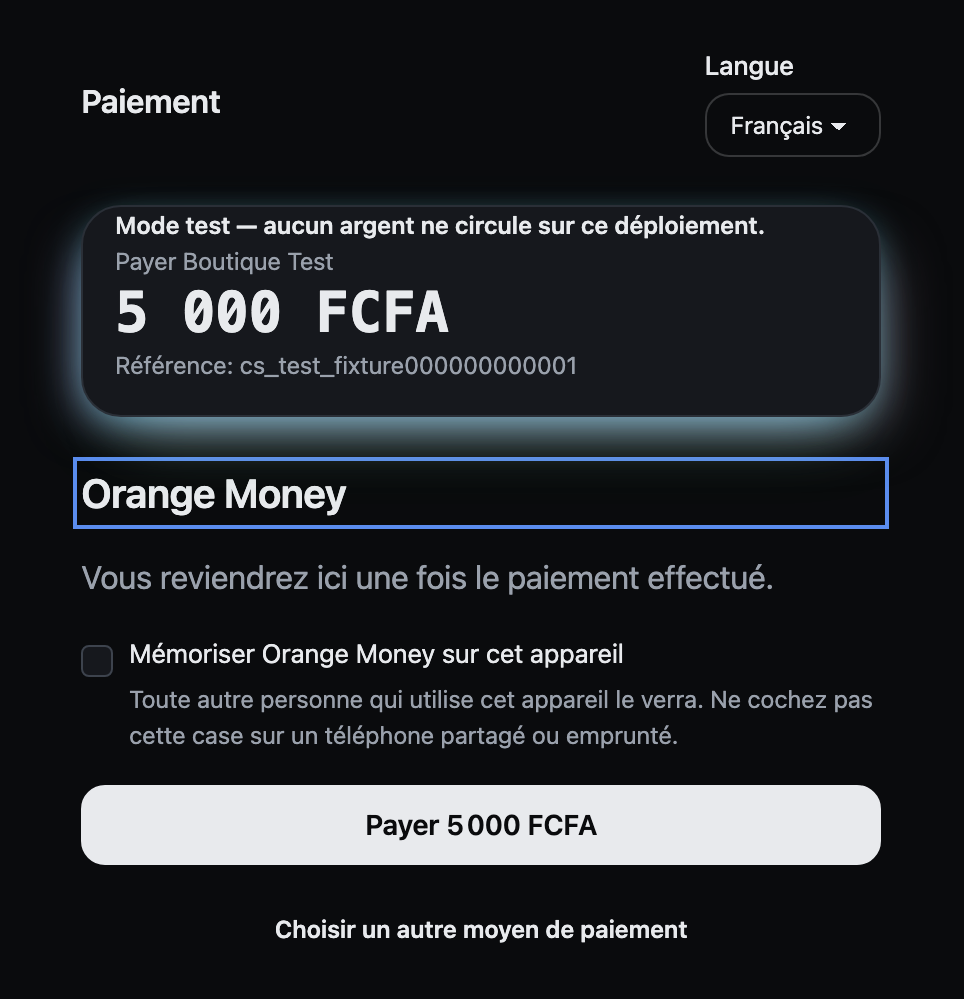
ready_redirect: Orange, before the hand-off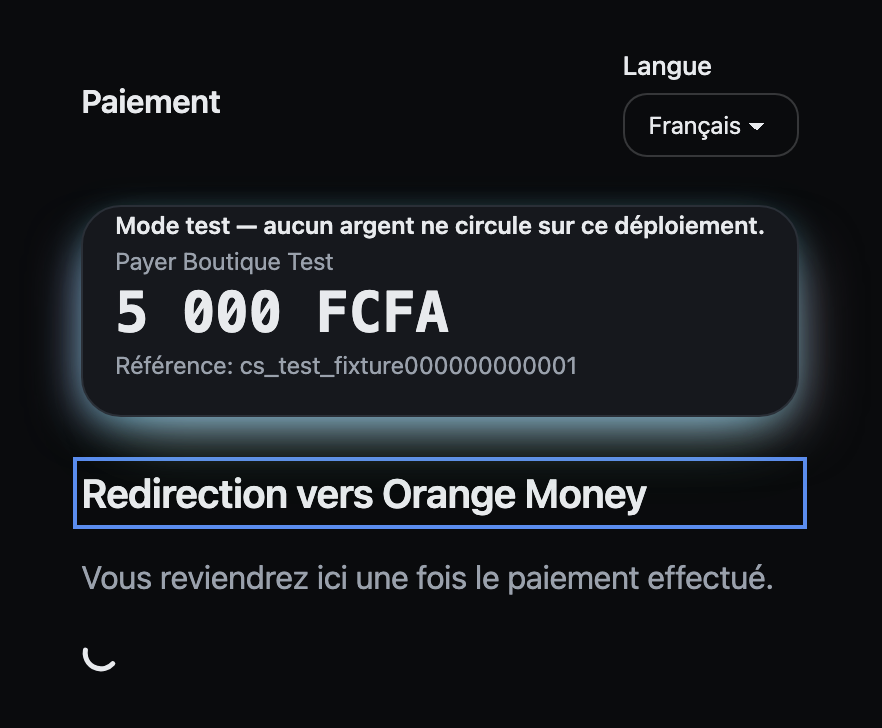
redirecting: leaving for the rail's page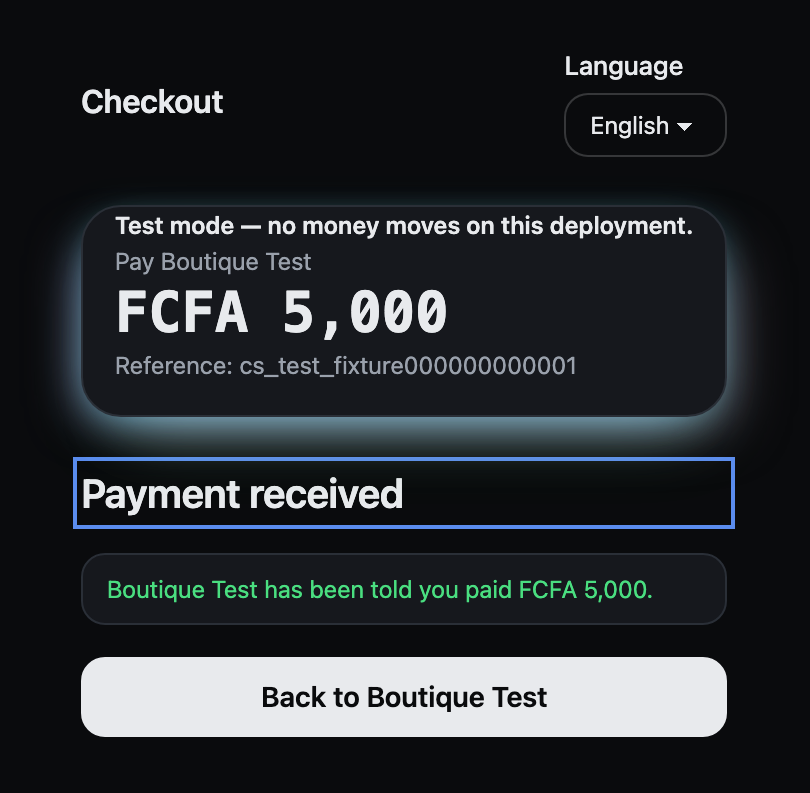
outcome: succeeded, with one button and no timer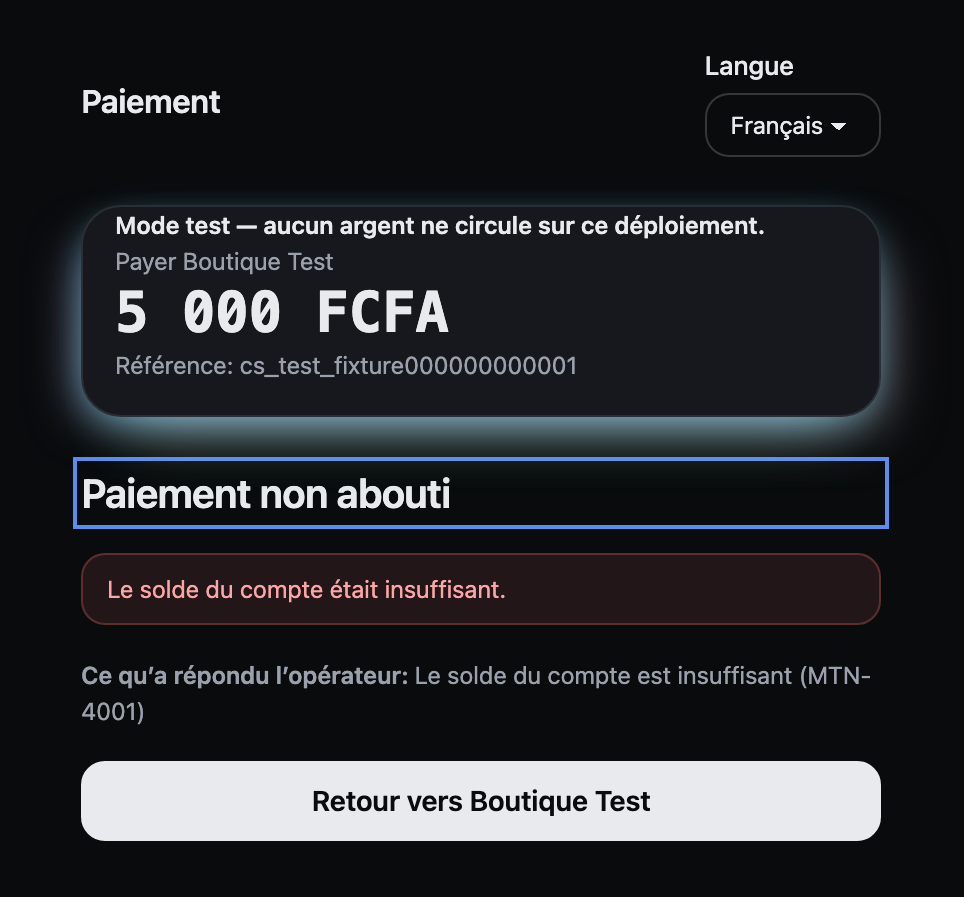
outcome: failed, with the rail's own words under the translated reason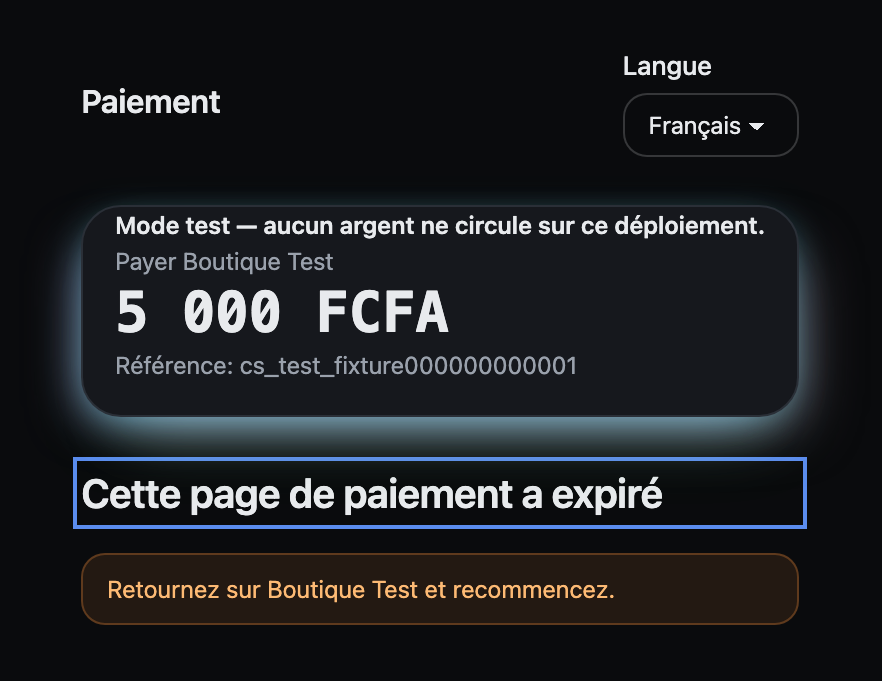
expired: the session is past its horizonWhat these screenshots are, and what they are not
They are vpay's real components, rendered with fixture state. They are not a capture of a live payment. No rail answered behind them, and at v0.4.1 no real payer has seen any of these screens.
A few properties worth knowing:
- Nothing happens on a timer. Every outcome — succeeded, failed, canceled — ends in one button, "Back to {merchant}". An earlier five-second auto-forward was removed because it took the failure reason away from a payer still reading it.
- A failed outcome shows the rail's own words where the API returned any, labelled as the provider's and rendered as text, under the translated sentence.
- The embed check runs before the credential is read, so a refusal cannot be used to probe a link.
- The language switch does not navigate (that would drop the fragment, which is the credential). The initial locale comes from
Accept-Language, French by default. - No floating point in the money path.
5000 XAFis formatted by moving a decimal point through the integer's digits, never byminor / 100. - The return page has its own smaller machine with no confirm at all: it holds no intent secret, so it polls, shows the outcome and forwards.
Embedded mode: framing and messages
The page talks to its framer with postMessage, and event.origin is checked on both sides against a pinned value — '*' appears nowhere as a target, and the parent never posts into the frame.
| Message | Direction | Why |
|---|---|---|
vpay:resize | child → parent | The frame starts at height: 0; the page reports its height |
vpay:complete | child → parent | { session, status } — the cs_… id, never a secret |
vpay:redirect | child → parent | The frame is sandboxed without allow-top-navigation, so the parent navigates to the rail |
There are two locks on framing: the frame-ancestors header (computed server-side from the merchant's checkout_origins, failing closed to 'none' four ways), and the page's own comparison of its framer against the same list. An empty checkout_origins — the default — means no site may frame the page. Origins must be spelled canonically (lower-case host, no default port) or boot refuses them.
Configuring the page
One image serves every operator. Two YAML files are read once at container start — never at build time:
| File | Default path | Override |
|---|---|---|
branding.yaml | /etc/vpay/checkout/branding.yaml | VPAY_CHECKOUT_BRANDING_FILE |
config.yaml | /etc/vpay/checkout/config.yaml | VPAY_CHECKOUT_CONFIG_FILE |
# config.yaml
checkout:
  public_base_url: https://checkout.example
  allowed_methods: [mtn_momo, orange_money]
  features:
    page_memory: true
display_name in branding.yaml is the operator's name and never stands in for the merchant's; allowed_methods can only narrow what the intent offers, and an empty list is ignored with a warning rather than refusing every payment. A missing or bad file costs only the affected key and logs one WARN.
With page_memory on, a payer may opt in to the page remembering their number and last rail on their own device (IndexedDB, 90 days). There is no PIN store, deliberately: neither rail takes a PIN through vpay's API, so a PIN field would go nowhere — and on a payment page it would look like phishing.
On the API side, the operator sets checkout.public_base_url and each merchant's publishable_keys, display_name and (for embedded) checkout_origins — the runbook has the full YAML. See Configuration.
What can go wrong
| Symptom | Cause |
|---|---|
Create answers checkout_not_configured | No checkout.public_base_url. It is a 500, not 503 — a recorded maintainer decision |
Create is a 400 naming payment_intent | The intent is not requires_payment_method, has a charge, or already has an open session |
| The payer's page says "invalid link" | The URL lost its fragment — copied through a redirect, a logger or a query-only link |
| The embedded iframe is an empty box | The page never painted, so no vpay:resize arrived. Check the browser console |
| "This page will not load here" | The framing origin is not in that merchant's checkout_origins |
| The order never turns paid though vpay says succeeded | The merchant's webhook endpoint — verify the raw bytes and the secret |
Status in v0.4.1
| Part | Status | Evidence |
|---|---|---|
| Sessions, routes, lifecycle, confirm refusal | Built and tested | Container-backed cases in checkout_sessions.rs against real Postgres |
| Hosted and embedded page, both rails | Partly built | Cypress shop-hosted.cy.ts and shop-embedded.cy.ts green through examples/shop — against WireMock rails |
| A real rail behind the page | Not built | Orange's "hosted page" is a WireMock mapping; nothing shows Orange accepts the return URL |
frame-ancestors enforced by a browser | Written, never run against the real rail | Cypress strips CSP, so the header is asserted as sent; only the page's own origin check was observed refusing |
checkout.session.expired delivery | Partly built | Emitted and fanned out in tests; no merchant endpoint outside the repository has received one |
| Popup mode | Written, never run against the real rail | Unit cases against stub windows; no test opens a real popup |
| Page memory | Written, never run against the real rail | Driven against a hand-written IndexedDB stub; no real browser's IndexedDB observed |
| Rate limiting on the browser surface | Not built | Must be done at the ingress; nothing in vpay enforces or checks it |
Content policy beyond frame-ancestors | Not built | No script-src / default-src; a stated gap |
| Running in Kubernetes | Not built | The chart templates it (checkout.enabled, off by default) and supplies no ConfigMap for the YAML; no pod has run it |
The full record, including every dated correction, is hosted-checkout.md § Status and not-built-and-not-proven.md. Overall standing is on Status.
Go deeper
- The hosted checkout flow — the design, the routes, the credentials
- The page's state machine and outcome screens
- Runtime configuration
- Page memory, the iframe protocol, the popup, the headers
- What is not built and not proven
- The integration runbook — both modes, worked through
examples/shop - The reducer
- Skill: vpay-checkout; for the frontend workspace, vpay-frontend