
Payment lifecycle
A PaymentIntent is vpay's record of one attempt to collect one amount from one payer. It follows Stripe's shape closely enough that a merchant who knows Stripe can read it, but it is built around a fact Stripe never had to face: on mobile money the rail may take minutes or hours to give a final answer, and the two Cameroon rails involve the payer in completely different ways. This page explains the states, the two flow shapes, and the rule that holds the design together — one charge per intent, forever.
Agents working on this should load vpay-payments.
Two flow shapes
The core never branches on a rail's name. It branches on a capability value, ProviderFlow, which is either push or redirect.
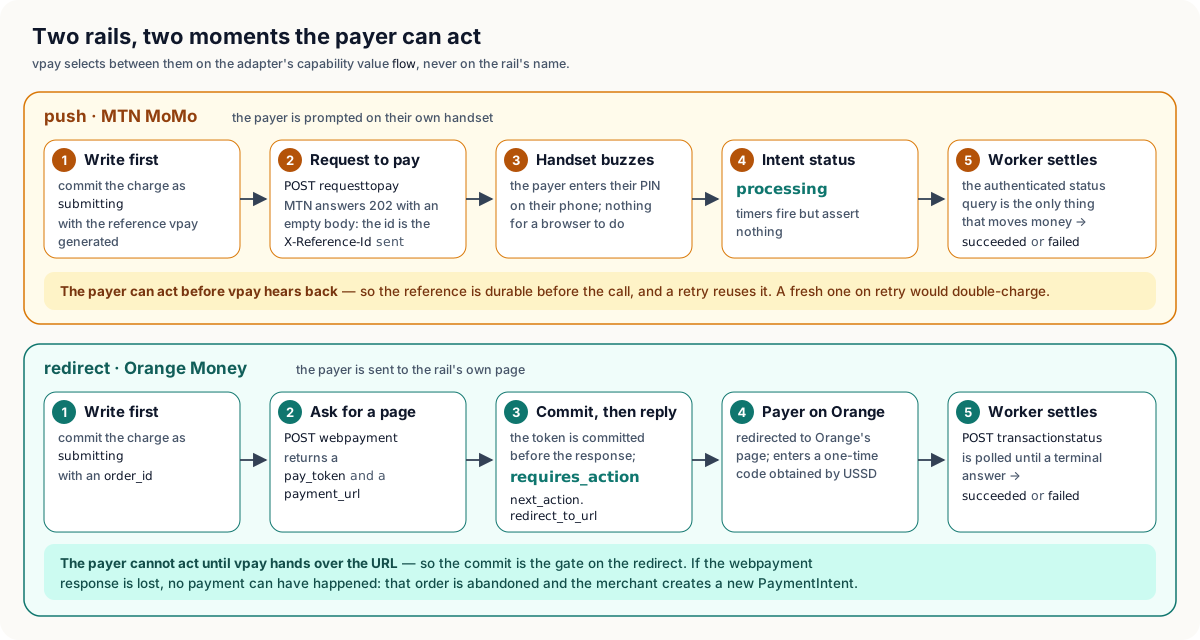
| push (MTN MoMo) | redirect (Orange Money) | |
|---|---|---|
| How the payer acts | A prompt on their handset; they enter a PIN | Redirected to the rail's hosted page; they enter an OTP from USSD |
| Who holds the payer identifier | vpay — it is an input to submit | The rail. vpay may never learn it |
| What submit returns | An acknowledgement with no id | A pay_token and a URL to redirect to |
Intent status after confirm | processing | requires_action |
| Can the payer act before vpay persists? | Yes | No |
That last row is why crash safety has two halves: the moment at which vpay must have written things down is different for each shape.
States
This is the state diagram from vpay's own flow document, with the states named exactly as it names them. Note that failed here is not an intent status — the diagram uses it as an alias for "back in requires_payment_method, carrying last_payment_error".
stateDiagram-v2
    direction TB
    [*] --> requires_payment_method : create
    requires_payment_method --> canceled : cancel
    requires_payment_method --> processing : confirm on a push rail
    requires_payment_method --> requires_action : confirm on a redirect rail
    requires_action --> succeeded : rail says succeeded
    requires_action --> failed : rail says failed
    processing --> processing : timers only
    processing --> succeeded : rail says succeeded
    processing --> failed : rail says failed
    state "requires_payment_method + last_payment_error" as failed
    succeeded --> succeeded : refund
    succeeded --> [*]
    canceled --> [*]
    failed --> [*]
The enum itself (IntentStatus in vpay_core::state) has exactly five values: requires_payment_method, requires_action, processing, succeeded, canceled. There is no requires_confirmation — confirm always submits — and no failed.
This diagram follows the code, not vpay's flow doc
vpay's payment lifecycle flow draws a requires_action → processing step. The code at v0.4.1 never takes it, so it is not drawn here. The settlement's guard accepts an intent in processing, requires_action or requires_payment_method (SETTLEABLE_STATUSES in vpay_db::payment_intents). A redirect charge's intent stays in requires_action until the worker settles it, and a settlement can also land on an intent still in requires_payment_method when a confirm crashed before moving it — see crash safety.
The rules behind the transitions
requires_actionis redirect-only. It carries Stripe's ownnext_action.redirect_to_urlshape, so existing redirect handling works. A push rail never enters it: nothing needs a browser while a payer types a PIN into their own handset.processingleaves only on a terminal answer from the rail. Timers fire but assert nothing. A payment still pending at minute 15 may succeed at hour 30; pretending otherwise is how you double-charge. See the reconciler.- Only a rail-reported failure fails a payment. The intent returns to
requires_payment_methodwithlast_payment_errorpopulated. That is terminal in practice, because the intent can never have a second charge. canceledis reachable only fromrequires_payment_method. Once a rail has the request, it cannot be recalled. Cancel also refuses an intent with a live charge.- Refunds do not change intent status. A refund is a separate object.
One charge per intent, forever
CREATE UNIQUE INDEX one_charge_per_intent ON charges (payment_intent_id);The index is deliberately not partial. Scoping it to live charges would let a second charge be inserted the moment the first moved to failed — and a failed charge can be one vpay recorded before the rail's answer was final.
So a retry means a new PaymentIntent. This is the one place vpay's API is noticeably less convenient than Stripe's, on purpose.
Create, confirm, settle: push rail
sequenceDiagram
    autonumber
    participant M as Merchant
    participant S as vpay-server
    participant DB as Postgres
    participant R as MTN MoMo
    participant W as vpay-server worker
    M->>S: POST /v1/payment_intents
    S->>DB: insert intent in requires_payment_method
    S-->>M: 200 payment_intent
    M->>S: POST /v1/payment_intents/{id}/confirm with msisdn
    S->>DB: commit charge in submitting plus its poll_charge job
    S->>R: POST /collection/v1_0/requesttopay
    R-->>S: 202, empty body
    Note over R: payer's handset prompts for a PIN
    S->>DB: charge submitted, intent processing
    S-->>M: 200, status processing, next_action null
    loop poll ladder
        W->>R: GET /collection/v1_0/requesttopay/{ref}
        R-->>W: pending, or a terminal answer
    end
    W->>DB: one transaction - charge succeeded, intent succeeded, event written
    W->>M: webhook payment_intent.succeeded
Create, confirm, settle: redirect rail
sequenceDiagram
    autonumber
    participant M as Merchant
    participant P as Payer browser
    participant S as vpay-server
    participant DB as Postgres
    participant R as Orange Money
    participant W as vpay-server worker
    M->>S: POST /v1/payment_intents
    S-->>M: 200, requires_payment_method
    M->>S: POST /v1/payment_intents/{id}/confirm with return_url
    S->>DB: commit charge in submitting, return_url, poll_charge job
    S->>R: POST /webpayment
    R-->>S: pay_token and payment_url
    S->>DB: commit pay_token and redirect_url on the charge
    S-->>M: 200, requires_action, next_action.redirect_to_url
    M->>P: redirect to the rail's page
    P->>R: enter OTP from USSD
    loop poll ladder
        W->>R: POST /transactionstatus with order_id, amount, pay_token
        R-->>W: pending, or a terminal answer
    end
    W->>DB: one transaction - charge, intent, event
    W->>M: webhook payment_intent.succeeded
In both shapes the next_action a merchant receives is rendered only from the committed charge row, never from the adapter's in-memory answer.
Where these diagrams have actually run
Both sequences run end to end in CI against WireMock hosts that answer the way vpay's documents say the rails answer. Against a real rail, only the push sequence has run, once, against MTN's sandbox with a test number that settles automatically. The redirect sequence has never met Orange, and no webhook has ever reached a merchant endpoint outside the vpay repository.
What confirm can answer
| Outcome | Response | What moved |
|---|---|---|
| Push rail accepts | 200, processing, next_action: null | charge submitted |
| Redirect rail accepts | 200, requires_action, next_action.redirect_to_url | charge submitted with the rail's token and URL, committed before the response |
| Rail declines | 409 charge_declined | charge failed with a failure_code; intent stays requires_payment_method with last_payment_error; one payment_intent.payment_failed |
| Transport, malformed answer, misconfiguration | an error (e.g. 502 provider_unavailable) | nothing — the charge stays submitting, because vpay does not know what the rail did |
What each status means to a merchant
| Status | What it means | What to do |
|---|---|---|
requires_payment_method | Created and not confirmed — or a charge was declined (last_payment_error is set) | Confirm it; if last_payment_error is set, create a new intent to retry |
requires_action | Redirect rail: the payer must visit next_action.redirect_to_url | Send the payer there; wait for the outcome |
processing | The rail has the charge and vpay is polling it | Do not ship. Do not open a second intent — on a push rail that prompts the handset again |
succeeded | The rail reported the money moved; amount_received = amount | Fulfil the order |
canceled | Withdrawn before any rail saw it | Nothing will be charged |
A decline carries a FailureCode, and which codes are reachable depends on the rail: MTN can produce all eleven, Orange only three. See failure codes.
What can go wrong
- A cancel racing a settlement. A confirm can commit its charge while a cancel's transaction is open. The settlement's own status guard then matches nothing (
canceledis not settleable) and rolls back loudly. There is one terminal state and one terminal event, but the rail took money for a withdrawn intent. vpay has no repair path for this; an operator reconciles it. - The rail never answers. After 24 hours the charge becomes
unresolvedand a human is alerted; the intent stays where it is and polling continues hourly. See the reconciler.
Status in v0.4.1
| Part | Status | Evidence |
|---|---|---|
Transition table (next_status) | Built and tested | Proven exhaustive over every (status, verb) pair in vpay_core::state |
| Create and cancel over HTTP | Built and tested | Integration tests; cancel emits payment_intent.canceled in the same transaction |
| Confirm reaching a rail | Partly built | Proven against WireMock; MTN's charge path settled once against MTN's real sandbox (2026-09-15) |
| Settlement by the worker | Partly built | worker_e2e.rs drives a real confirm through the real loop — against a WireMock rail |
| Orange redirect flow on a real rail | Written, never run against the real rail | Orange has never been called |
prompt_expired_at and the payment_intent.processing milestone | Not built | Named as never having happened in the source |
Partial amount_received | Not built | Neither rail can collect part of an amount |
The full record is the Status section of the payment lifecycle flow.
Go deeper
- docs/flows/payment-lifecycle.md — the source of truth for this page
- docs/flows/crash-safety.md — why the write order differs per flow shape
- docs/flows/reconciler.md — what drives
processingto a terminal state - docs/flows/failures.md — the
FailureCodevocabulary vpay_core::state— the enums and the transition table- Skill: vpay-payments