
The provider port
vpay's core decides what a payment means — its lifecycle, its ledger, its reconciliation, its failure vocabulary. An adapter decides how to say that on one rail's wire. Between the two sits a single Rust trait, ProviderAdapter, in backends/crates/vpay-provider. Everything rail-specific lives behind it, so adding a third Central African rail is meant to be an adapter crate and some configuration, not a change to the core.
The rule that keeps it honest is mechanical and greppable: if if provider == "mtn_momo" appears anywhere outside an adapter crate, the port is wrong — fix the port, not the caller (ADR-0002).
Agents working on an adapter or on the port itself should load vpay-provider-adapters.
The shape of the port
The HTTP layer only ever holds adapters as Box<dyn ProviderAdapter> — trait objects whose concrete type it cannot name. That is what makes a rail-name branch structurally awkward outside an adapter crate. Every shipping adapter is additionally wrapped in vpay_provider::Measured, a decorator that records vpay_provider_requests_total per port call.
classDiagram
    class ProviderAdapter {
        <<trait>>
        +code() str
        +capabilities() Capabilities
        +submit(charge, config) Submitted
        +query_status(charge, config) ChargeStatus
        +parse_callback(body) CallbackRef
        +parse_destination(raw) RefundTarget
        +refund(charge, amount, destination, config) Refunded
        +account_holder_name(msisdn, config) AccountHolder
    }
    class Capabilities {
        flow Push or Redirect
        supports_refunds
        supports_partial_refunds
        delivers_callbacks
        requires_ip_allowlist
        supports_account_holder_lookup
        refund_destination Origin or Required
    }
    class Measured {
        wraps every shipping adapter
        emits vpay_provider_requests_total
    }
    class MtnMomo {
        vpay-adapter-mtn-momo
        flow Push
    }
    class OrangeMoney {
        vpay-adapter-orange-money
        flow Redirect
    }
    ProviderAdapter ..> Capabilities : declares
    MtnMomo ..|> ProviderAdapter
    OrangeMoney ..|> ProviderAdapter
    Measured ..|> ProviderAdapter
    Measured o-- ProviderAdapter : inner
The operations
| Method | What it promises |
|---|---|
submit | Ask the rail to take a payment. Idempotent on reference_id: a duplicate submission must answer Submitted, never an error, which is what makes a same-reference retry after a crash safe. A redirect rail returns its redirect_url and its key material (ref_extra) in the same value, so a caller cannot hold one without the other. |
query_status | The authoritative read, and the only thing that moves money. Takes the whole charge, because some rails need the amount and their own token. Must keep working indefinitely. |
parse_callback | Turns a notification body into identifiers only — never a status. Deliberately synchronous, so it cannot make a network call and cannot smuggle a status out of an unauthenticated request. |
parse_destination | Optional. Reads the adapter's own destination[<rail_code>][…] sub-map from a refund request into a RefundTarget. The core strips the rail code and interprets nothing inside. |
refund | Optional, gated by supports_refunds. Answers Refunded — which carries fee: Option<Money> rather than a redirect URL. The default body is ProviderError::Unsupported. |
account_holder_name | Optional, gated by supports_account_holder_lookup. Defaults to ProviderError::Unsupported. See account-holder lookup. |
capabilities | A static declaration the core reads instead of special-casing a rail. |
The three network methods are async via #[async_trait] (a native async fn would not be dyn-safe). ProviderConfig carries base_url, callback_url, currency, settings, credentials and two deadlines, connect_timeout and request_timeout — on the config rather than the HTTP client, because one reqwest::Client is shared by every rail.
What every rail call inherits
All outbound rail traffic goes through vpay_provider::http, so both adapters share the same refusals: redirects are returned rather than followed, proxy environment variables are ignored, and response bodies are capped at 256 KiB. None of these is rail-specific, which is why they live in the port crate.
Branch on capabilities, never on provider codes
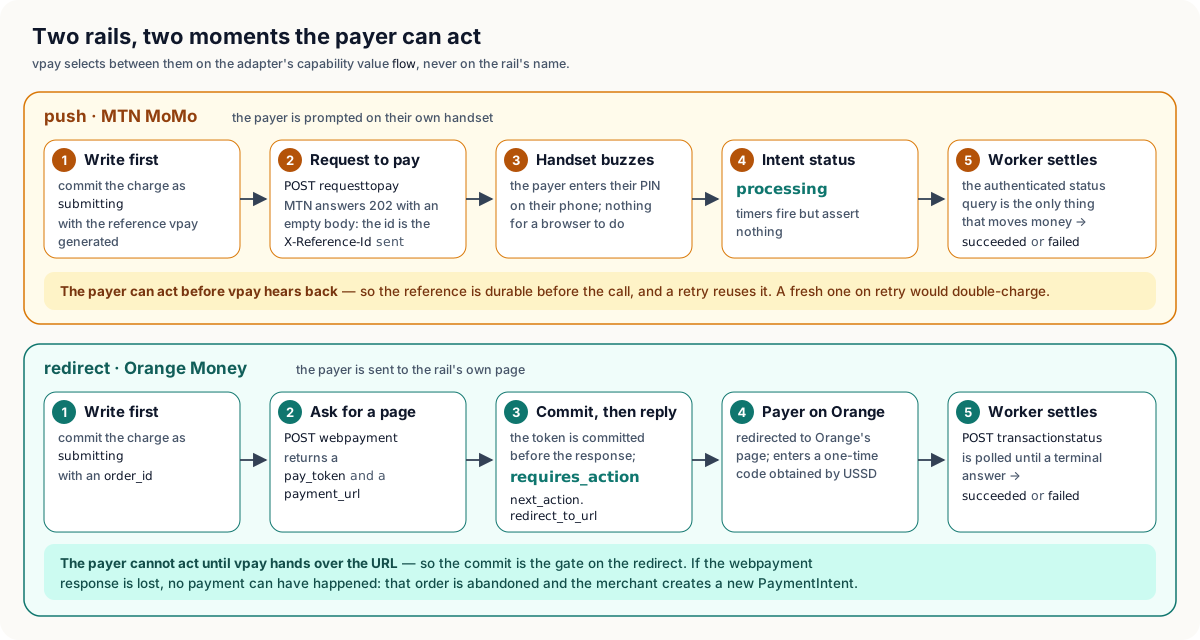
The core asks an adapter what it can do and acts on the answer. The two capabilities ADR-0002 names are flow and supports_refunds; the port now declares seven.
| Capability | mtn_momo | orange_money | What the core does with it |
|---|---|---|---|
flow | Push | Redirect | whether a confirm needs a payer number or a return URL, and whether submit may answer a redirect_url |
supports_refunds | true | true | refuses a refund on a rail with no refund API, with no rail-specific branch |
supports_partial_refunds | true | false | refuses a part-refund on a rail that declares false |
delivers_callbacks | true | true | whether to expect a notification at all — which is a hint either way |
requires_ip_allowlist | true | false | an operational fact for a deployment, not a code path |
supports_account_holder_lookup | true | false | refuses GET /v1/account_holders with a 400 on a rail with no such API |
refund_destination | Required | Required | whether a refund needs an explicit payee; read by the refund route |
flowchart TD
    A["Core needs rail behaviour"] --> B{"adapter.capabilities()"}
    B -->|"flow = Push"| C["confirm requires a payer MSISDN<br/>intent goes processing"]
    B -->|"flow = Redirect"| D["confirm requires a return_url<br/>intent goes requires_action"]
    B -->|"supports_refunds = false"| E["refund refused, no rail branch"]
    B -->|"supports_account_holder_lookup = false"| F["lookup refused with a 400"]
    X["if provider == mtn_momo"] -.->|"a defect outside adapters"| G["fix the port, not the caller"]
Unsupported is a claim about the rail; NotImplemented is an admission about vpay
Two different errors mean "this will not work", and the difference is the point:
ProviderError::Unsupported— the rail has no such API. It is a permanent capability answer. Orange's account-holder lookup is this:supports_account_holder_lookup: falseand the port's default.ProviderError::NotImplemented("…")— the rail does have the API and vpay has not written the call. Such a rail declares the capabilitytrueanyway and overrides the method with a named token, whichcargo xtask verify-statusrequires to be listed in vpay's status page.orange_money::refundis the one such token at v0.4.1.
A rail leaving that list says nothing about whether its written call has ever been made. mtn_momo::refund left it on 2026-09-15 when the Disbursements call was written — and that call has never been made against MTN (see MTN MoMo).
Callbacks are hints
Neither rail signs its notifications or sends a shared secret, so anyone who can reach the callback URL can post anything to it. vpay's answer is that a callback is only ever a hint to look sooner:
parse_callbackextracts identifiers and nothing else — the body'sstatusfield is not read.POST /provider/{code}/callbackuses those identifiers only to bring the charge's already-queuedpoll_chargejob forward. It never writes charge or intent state, and it discards any key material the adapter extracted.- The worker then runs the authenticated
query_status— and that is what settles the charge.
sequenceDiagram
    autonumber
    participant Rail as Rail (MTN or Orange)
    participant CB as vpay-api callback route
    participant Ad as Adapter
    participant Jobs as jobs table
    participant W as vpay worker
    Rail->>CB: POST /provider/{code}/callback (unsigned body)
    CB->>Ad: parse_callback(body)
    Ad-->>CB: CallbackRef (identifiers only, never a status)
    CB->>Jobs: pull poll_charge forward (floor 10 s)
    CB-->>Rail: 202 (same answer whether or not the charge exists)
    Note over CB,Jobs: No charge or intent state is written here
    W->>Jobs: claim poll_charge
    W->>Ad: query_status(charge, config)
    Ad->>Rail: authenticated status query
    Rail-->>Ad: status
    Ad-->>W: ChargeStatus
    W->>W: settle the charge and intent in one transaction
The route answers the same 202 for a reference it does not recognise as for one it does, so it is not an oracle for "does this charge exist", and a rail does not retry forever. A body the adapter cannot parse is a 400; an unknown rail code is a 404.
The callback route has no rate limit
A job already due within ten seconds (the poll ladder's first rung) is left alone, but a charge parked further out is brought forward by every callback. A caller who knows a live charge's reference can therefore hold it at roughly one authenticated status query per worker claim. vpay's own docs state there is no rate limit, per charge or per source.
Stub rails are configuration, not code
ADR-0006 forbids any mock, fake, stub or dummy reachable from vpay-server or vpay-worker-bin. A stub rail is instead a wiremock/wiremock host named in configuration — the same providers[].host mechanism a deployment uses to reach a real rail. Sandbox, production and stub are three configuration profiles, not three code paths. cargo xtask verify-no-mocks enforces this in CI. Code that is not written returns ProviderError::NotImplemented; it never fabricates a success.
The cost is that local development needs Docker. The gain is that CI exercises the binary that ships.
The shared conformance suite
One suite, backends/tests/conformance/tests/adapter_conformance.rs, is parameterised over every adapter. It starts a real wiremock/wiremock container per rail and drives it over HTTP, using the mappings under backends/tests/conformance/wiremock/<rail>/mappings/ — the same directory the compose stack mounts. Adding a rail means making this suite pass, not writing a new one. Its cases cover, among others, that a duplicate submit reports Submitted, that "not found" is never on its own a failure, that an unreachable rail is a transport error and never a decline, that bad credentials are never reported as a payer problem, and that a callback round-trips to identifiers only.
What the suite cannot prove
Every conformance case talks to WireMock. A mapping faithful to vpay's own reading of a rail — but not to the rail — passes. The 401-after-a-good-token re-mint path has no mapping and is unproven on both rails.
Adding a rail
- Answer the preconditions for the flow shape during commercial negotiation. A push rail must let you supply your own idempotent reference and query final status by it indefinitely, because the payer's phone buzzes before you learn whether your request succeeded. A redirect rail must let you persist the submit response before the payer can act, and query status by what you hold afterwards.
- Add a
providers[]entry to the deployment's YAML — theproviderstable is reconciled from configuration at boot. No schema migration. - Write
backends/crates/vpay-adapter-<rail>/implementing the trait, with a mapping into the failure taxonomy. - Add WireMock mappings and make the shared conformance suite pass unchanged.
- Document the rail's quirks in a flow doc.
Nothing in the core changes. If a step reads "and also patch the reconciler", the port leaked.
What can go wrong
- A rising rail-call failure rate.
vpay_provider_requests_totalis labelled byerror_kind, and which kind dominates decides what is wrong:provider_unavailableis transport,charge_declinedis ordinary rail decisions,provider_erroris a rail string the adapter's table does not know (mapping drift),misconfiguredis our YAML or credentials. The alert and its threshold are provisional and have never been evaluated against real series — see the provider error-rate runbook and Runbooks. - Widening a mapping to swallow an unknown string is worse than an honest
provider_error, because it tells a merchant something false about whether to retry.
Status in v0.4.1
| Part | Status | Evidence |
|---|---|---|
The trait, capabilities and Measured decorator | Built and tested | Implemented in vpay-provider; unit-tested |
| Shared conformance suite over both rails | Built and tested | Runs against real wiremock/wiremock containers |
| Callback route as a hint | Partly built | Built and tested; never called by a real rail; no rate limit |
Orange notif_token comparison on callbacks | Not built | Route discards the received token; the comparison is unbuilt |
| MTN charge path over the port | Partly built | One sandbox payment settled on 2026-09-15 |
| Orange over the port | Written, never run against the real rail | WireMock only; Orange has never been called |
refund through the port | Written, never run against the real rail | MTN written and never called; Orange is NotImplemented; nothing settles a pending refund — the port has no refund status read |
| 401 → re-mint → retry | Written, never run against the real rail | No mapping exercises it on either rail |
The full, dated record is in vpay's provider-port flow § Status.
Go deeper
- The provider port flow — the full interface table and every capability decision
- ADR-0002: rails live behind a port
- ADR-0006: no test doubles in shipping processes
- Rails reference — per-adapter implementation notes, the callback URL contract
- Payment lifecycle and the reconciler on this site
- Skill: vpay-provider-adapters