
What is vpay
vpay is meant to be a small, provider-agnostic payment gateway for Cameroon and Central Africa. Merchants integrate it the way they would integrate Stripe, with the same object model, the same idempotency semantics and the same webhook signature scheme. Underneath, it talks to mobile-money rails that behave nothing like cards. MTN MoMo and Orange Money are the first two adapters. Neither of them defines the architecture.
vpay has never taken a real payment
At v0.4.1 vpay is a scaffold. It compiles, lints clean and its tests pass, but it cannot take a payment. Do not deploy it. Every payment in its history has settled against a WireMock stub, with one exception: a single MTN sandbox charge on 2026-09-15. See What works today.
Who it is for
| Reader | What vpay offers them |
|---|---|
| A merchant developer | A Stripe-shaped /v1 API (PaymentIntents, Checkout Sessions, Customers, Invoices, Events, Refunds), two merchant SDKs, a browser client and a hosted payment page |
| An operator | One static binary in a FROM scratch image, configured entirely by YAML in git (ADR-0003), with a dashboard that observes and never administers |
| A contributor | A repository that enforces its own honesty rules with build gates, so that what it says about itself stays checkable |
Two rails, two very different payer journeys
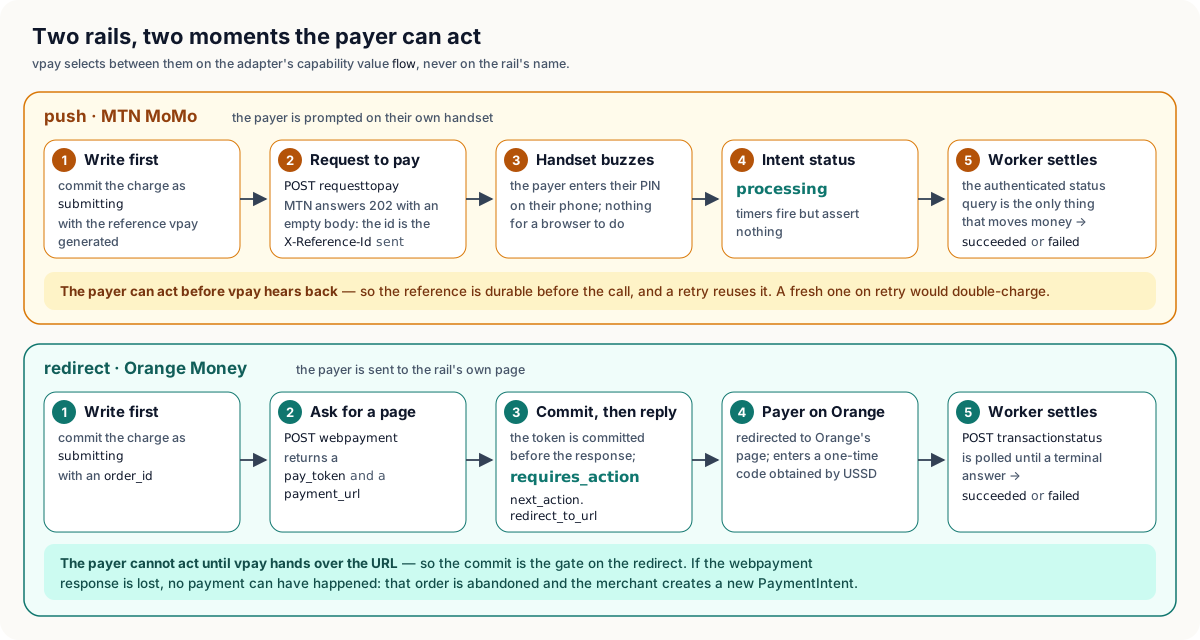
Card payments have one shape. Mobile money has at least two, and vpay's core picks between them using a capability value (flow), never a rail name.
MTN MoMo (push) | Orange Money (redirect) | |
|---|---|---|
| How the payer acts | Enters a PIN on their handset | Is redirected to Orange's hosted page |
Intent status after confirm | processing | requires_action |
| Who holds the payer's identifier | vpay (it is an input to submit) | The rail. vpay may never learn it |
| Can the payer act before vpay saves? | Yes | No |
The last row matters more than the others. On a push rail the payer's phone starts buzzing as soon as vpay calls MTN, so vpay must save the reference before it makes the call. On a redirect rail the payer cannot do anything until vpay hands over a URL, so vpay must save Orange's token before it redirects. That is why crash safety has two enforcement points instead of one.
flowchart LR
    C["POST /v1/payment_intents/{id}/confirm"] --> F{"capability: flow"}
    F -->|push| P["persist reference,<br/>then call the rail"]
    P --> PR["processing<br/>payer enters PIN on handset"]
    F -->|redirect| R["call the rail,<br/>persist its token"]
    R --> RA["requires_action<br/>next_action.redirect_to_url"]
    PR --> W["vpay-server worker polls<br/>the authenticated status query"]
    RA --> W
    W --> T["succeeded, or back to<br/>requires_payment_method"]
A Stripe-shaped API, and where the comparison breaks
The object model, the idempotency semantics and the webhook signature are all copied from Stripe on purpose, so that a merchant's existing knowledge and code carry over. The comparison breaks in three places:
- Authentication. This is the big one.
/v1accepts nosk_live_/sk_test_API key. Merchants authenticate with OAuth2client_credentialsplusprivate_key_jwt(RFC 7523). Each merchant is a statically registered client that holds its own private key, and vpay stores only the public half, in YAML (ADR-0010). The officialstripepackage can still reach vpay:@vaam-apps/vpay-sdk/stripesupplies aconfig.authenticator, sonew Stripe("", { authenticator, host, port, protocol })works with an empty key. See Stripe compatibility and Authentication. - Idempotency is required. Every
POSTmust carry anIdempotency-Key. Stripe makes the key optional. - A retry is a new PaymentIntent. An intent can have only one charge, ever (One charge per intent).
The shape of the system
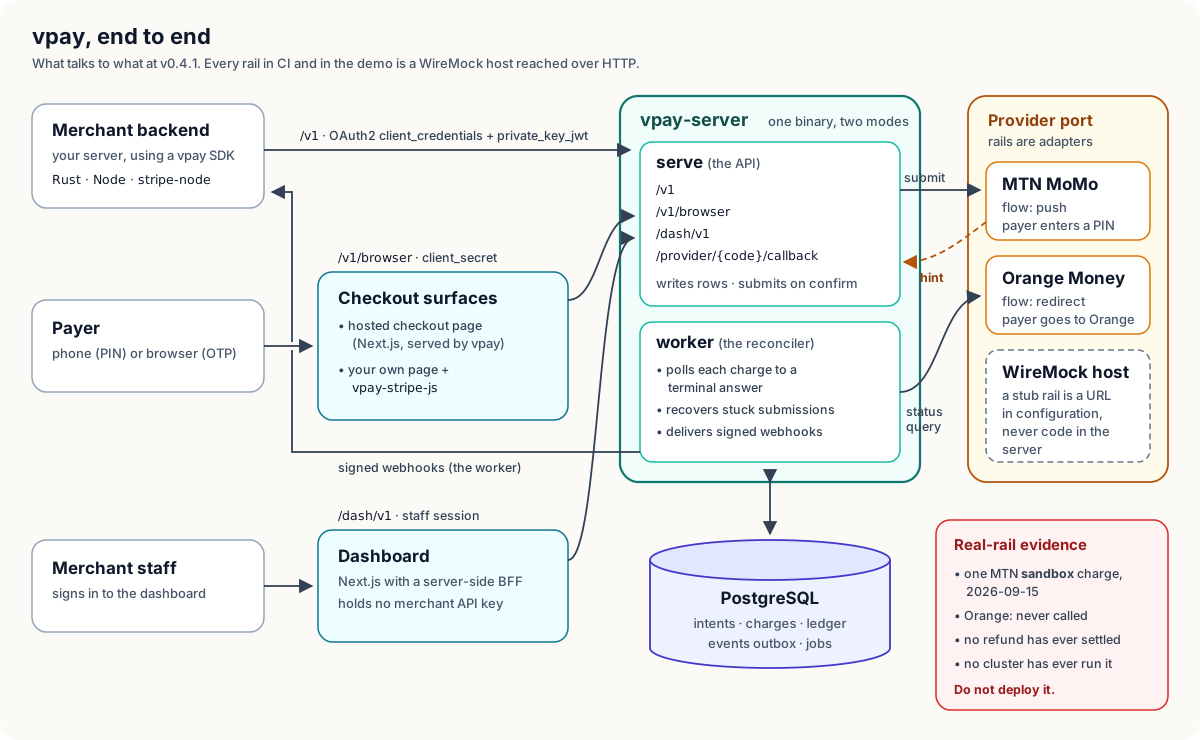
vpay ships as one binary, vpay-server, with several modes. With no subcommand it serves the API. vpay-server worker runs the job loop. The job loop polls rails, settles charges, delivers webhooks and escalates stuck payments. vpay-server staff add creates a dashboard account. Both of the long-running modes share one Postgres database.
flowchart LR
    M["Merchant backend<br/>(SDK or stripe-node)"] -->|"/v1 (bearer token)"| S
    B["Payer's browser<br/>(checkout page, stripe-js)"] -->|"/v1/browser (pk + client_secret)"| S
    ST["Staff (dashboard app)"] -->|"/dash/v1"| S
    RL["Rail"] -.->|"POST /provider/{code}/callback<br/>never called by MTN or Orange"| S
    S["vpay-server (serve)"] --> DB[("Postgres")]
    WK["vpay-server worker"] --> DB
    S -->|"submit on confirm"| RL
    WK -->|"authenticated status query"| RL
    WK -->|"signed webhooks"| M
| Surface | Who calls it | Today |
|---|---|---|
/v1 | A merchant's server, with a bearer token from POST /v1/oauth/token | Payment intents, checkout sessions, customers, invoices, events, refunds, account holders |
/v1/browser | A payer's page, with a publishable key and the intent's client_secret | Built, and walked by a real browser against stub rails |
POST /provider/{code}/callback | A rail (callbacks are hints only) | Proven against WireMock. MTN and Orange have never called it |
/dash/v1 | The dashboard app's server, under a staff session | Staff sign-in and read routes. None of the dashboard writes ADR-0008 describes is built |
GET /v1/balance is not routed anywhere, and it answers an honest 404. A refund can be created, but a 201 does not mean money came back. Nothing in v0.4.1 settles a pending refund, and no rail has ever refunded anything.
The two web apps and the SDKs
frontends/apps/checkoutis the payment page vpay serves, in hosted and embedded (iframe) modes. See Hosted checkout.frontends/apps/dashboardis where staff sign in and read one merchant's payments. It observes and does not administer (ADR-0008). See Dashboard.- Merchant SDKs.
sdks/rust(vpay-sdk) andsdks/nodejs(@vaam-apps/vpay-sdk) are held to one capability matrix.sdks/stripe-js(@vaam-apps/vpay-stripe-js) is the browser client for a payer's page.sdks/stripe-compatdrives the officialstripepackage against a live stack, andsdks/flutterholds a Flutter checkout plugin. No test insidesdks/nodejsitself has ever talked to a vpay: every server in that package's own tests is anode:httpstub. See SDKs.
The repository layout
flowchart TB
    subgraph BE["backends/"]
        CR["crates: vpay-core, -config, -db, -ledger,<br/>-provider, adapters, -api, -worker, -testkit"]
        AP["apps/vpay-server<br/>one musl binary, scratch image"]
        TS["tests: integration, conformance,<br/>webhook-receiver"]
    end
    subgraph FE["frontends/"]
        FA["apps: checkout, dashboard"]
        FP["packages: @vpay/tokens,<br/>@vpay/api-client, @vpay/config"]
        FT["tests/e2e (Cypress)"]
    end
    subgraph SD["sdks/"]
        SR["rust, nodejs"]
        SJ["stripe-js, stripe-compat"]
        SF["flutter"]
    end
    EX["examples/<br/>merchant-demo, shop, checkout-browser, ..."]
    SC["schemas/vpay.cstack"]
    DP["deploy/helm/vpay<br/>never applied to a cluster"]
    XT[".xtask/<br/>repo automation and verify gates"]
    DC["docs/<br/>adr, flows, runbooks, status.md, ..."]
    CR --> AP
    SR -->|"/v1"| AP
    FA -->|"/v1/browser, /dash/v1"| AP
The backend is Rust (edition 2024) with axum, sqlx and rustls only. It builds static musl binaries into FROM scratch images with mimalloc. The frontend is Next.js 15 and React 19 in strict TypeScript. examples/shop runs on Next 16.
Two rules the repository enforces on itself
Both rules are wired into just verify and CI.
- No test doubles in shipping processes. No mock, fake or stub may be reachable from
vpay-serverin any of its modes. A stub rail is a WireMock host in configuration, reached over HTTP exactly as a real rail would be (ADR-0006). - Never claim a feature is done when it is not. Code that has not been written returns
ProviderError::NotImplementedand never fakes a success. Every such path must be declared indocs/status.md, andcargo xtask verify-statusfails in both directions if the code and the page disagree.
Rails also stay behind the port. Code outside an adapter crate that branches on a provider code, as in if provider == "mtn_momo", is a defect (ADR-0002, Provider port).
Status in v0.4.1
| Part | Status | Evidence |
|---|---|---|
| End-to-end payment against stub rails | Partly built | just demo walks six payments on both rails. Every rail in those runs is a WireMock container |
| MTN MoMo charge path | Partly built | One EUR sandbox charge settled on 2026-09-15. The payer was a test number, and no money moved |
| Orange Money | Written, never run against the real rail | Wire calls proven against WireMock only. Orange has never been called |
| Refunds | Written, never run against the real rail | Routes exist. Nothing settles a pending refund, and no rail has ever refunded anything |
| A deployment | Not built | The Helm chart renders and is schema-validated. No cluster has ever run vpay |
See What works today for the full picture, and docs/status.md for the record.
Go deeper
- README.md: the project's own front page, including the
/v1route table and the layout - AGENTS.md: the rules, the standards and the architecture rules every change follows
- Payment lifecycle flow: the two flow shapes and every state
- ADR-0002 and ADR-0010: the port and merchant authentication
- Agents orienting in this repository should load the vpay skill first. It routes to the rest.